 New York Divorce Lawyer Blog


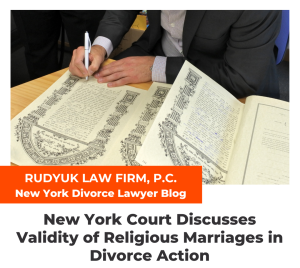 Marriage disputes sometimes arise years after a ceremony, particularly when questions surface about whether a marriage was legally valid in the first place. These issues become especially complex when the relationship began with a religious ceremony but without a formal marriage license. A recent New York ruling demonstrates how New York courts analyze the legal validity of such marriages and highlights how prior actions taken by the parties themselves can affect the outcome. If you are involved in a divorce where the validity of a marriage is being challenged, it is essential to speak with an experienced New York family law attorney who can evaluate how state law may apply to your situation.
Case Setting
It is reported that the wife commenced an action for divorce and ancillary relief in 2023, alleging that the parties were married in 2014 during a Jewish ceremony officiated by a rabbi. Allegedly, the parties executed a religious marriage contract known as a ketubah during that ceremony, but did not obtain a civil marriage license afterward.
Allegedly, the husband previously initiated a divorce action against the wife in 2015, which proceeded for several years before the parties reconciled and voluntarily discontinued the case. In the later divorce action, the husband moved for summary judgment, seeking dismissal of the complaint, arguing that the parties had never been legally married. The husband asserted that the rabbi who performed the ceremony lacked proper authorization and that a religious tribunal had declared the ketubah invalid several years after the ceremony. The husband also sought sanctions against the wife. The trial court denied those requests, and the husband appealed.
Determining If a Marriage is Valid Under New York Law
On appeal, the court affirmed the lower court’s ruling and held that the parties’ marriage was valid under New York law. The court explained that even when parties fail to obtain a marriage license, a marriage may still be legally valid if it was properly solemnized in accordance with the Domestic Relations Law. In general, a marriage is considered solemnized when the parties declare that they take each other as spouses in the presence of a qualified officiant and witnesses.
The court rejected the husband’s argument that the rabbi’s alleged lack of religious authorization invalidated the marriage. Courts apply neutral legal principles when addressing such disputes and will not invalidate a civil marriage based solely on a religious body’s internal determination about the officiant’s authority.
The court also rejected the husband’s claim that the later decision by a religious tribunal declaring the ketubah void dissolved the marriage. Under New York law, once marriage is established, it creates a legal status governed by state law, and the later dissolution of a religious contract does not terminate a civil marriage.
The court further concluded that the husband was barred from denying the existence of the marriage under the doctrine of judicial estoppel. Having previously filed a divorce action based on the same marriage and litigated that case for several years, the husband could not later take the opposite position and claim that the marriage never existed simply because circumstances had changed. The appellate court also upheld the denial of sanctions, finding no evidence that the wife engaged in frivolous conduct.
Meet with an Experienced New York Divorce Attorney
Challenges to the validity of a marriage can dramatically affect every aspect of a divorce, from property division and support to the court’s authority to grant relief in the first place. If you are facing a divorce where the existence or validity of a marriage is being questioned, working with a knowledgeable attorney can help ensure your rights and financial interests are fully protected. Attorney Ksenia Rudyuk of RLF Family Law is an experienced New York divorce attorney who handles complex New York matrimonial matters and can guide you through every stage of the process. Contact RLF Family Law at (212) 706-2001 or complete our online form to schedule a meeting.